Most content being written about Generative Engine Optimisation (GEO), also called Answer Engine Optimisation (AEO), Ai search optimisation or LLM Optimisation (LLMO), is aimed at e-commerce or consumer businesses. That’s understandable; search visibility has always been more commercially urgent for high-volume, transactional categories. But if you run a professional services or financial services firm, the implications are arguably more significant.
What is GEO — and why does it matter now?
The concept goes by several names depending on who’s talking about it. “GEO” (Generative Engine Optimisation) is often associated with the content marketing world. “AEO” (Answer Engine Optimisation) was coined earlier, when voice search and featured snippets were the primary concern, the idea that people want answers, not links. “LLMO” (Large Language Model Optimisation) is the more technical framing, focused specifically on how well your content is understood and cited by AI models. Some people use “AI search optimisation” as a catch-all.
The names differ; the goal doesn’t. It’s about structuring and creating content so it’s more likely to be surfaced by AI tools such as ChatGPT, Perplexity, and Google’s AI Overviews when people ask questions relevant to your business.
Traditional SEO has been about ranking in a list of links. GEO/AEO is about being the answer.
For professional services, that shift matters more than it might seem. Your buyers weren’t likely to click through twenty search results anyway. They were always going to read reviews, ask someone they trust, or call a contact for a recommendation. What’s changed is that “someone they trust” increasingly includes an AI assistant.
Your buyers are already using it
According to a global study of nearly 4,000 buyers by 6sense, 94% of B2B buyers reported using a large language model at some point in their buying journey. That’s not a gradual trend. Forrester confirms that LLM adoption in B2B purchasing went from essentially zero in January 2024 to 89% by mid-2024.
For founders who rely on referrals and word of mouth, this is worth sitting with. The person considering hiring your firm is asking ChatGPT things like “what should I look for in a B2B marketing consultant for a fintech company?” or “what does a good fractional CMO do for a scale-up?” before they ever talk to a person.
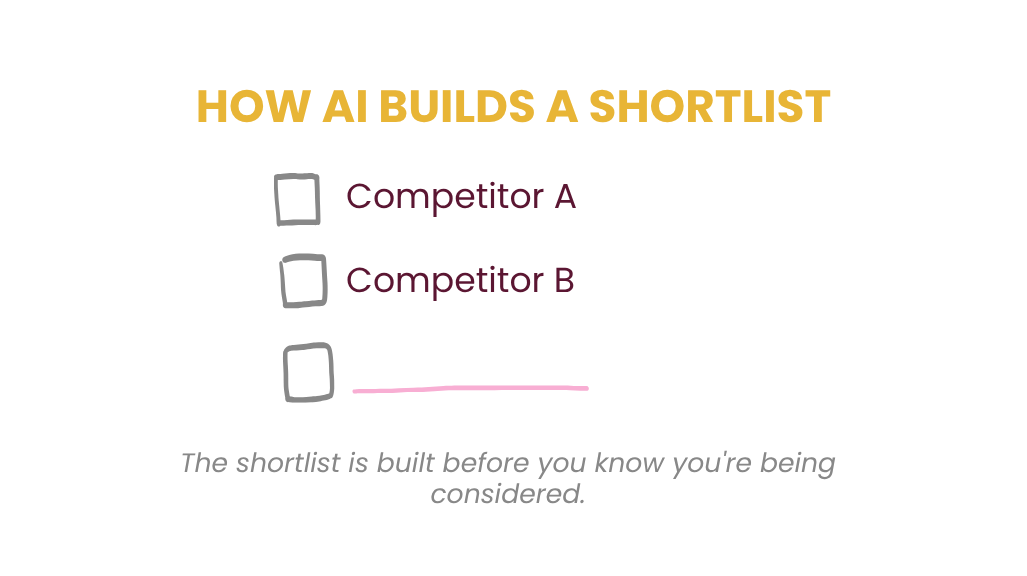
Here’s the part that matters most for service businesses: 94% of buying groups rank preferred vendors before first contact, and 80-84% of the time they buy from whoever topped that list. Those shortlists are built on prior experience, not AI discovery. If your firm isn’t already on a buyer’s radar, an AI assistant probably won’t put you there. The shortlist is being built before you know you’re being considered.
If your business isn’t showing up credibly in AI-generated answers, you’re losing ground at the very top of the funnel, quietly, with no signal in your analytics.
Why professional services is more exposed than it thinks
B2B service firms have historically got away with thin digital content. Relationships, reputation, and referrals have done the heavy lifting. A decent website, some LinkedIn activity, maybe a few case studies, long deemed enough.
That model is under more pressure than most people are acknowledging. Industry studies now show an average decline in organic traffic of between 18% and over 30% for queries served with an AI Overview, with click-through rates for the top organic position dropping by as much as 34.5%. By 2028, Gartner predicts organic search traffic to websites will decrease by 50% or more as generative AI search scales. (Gartner)
AI tools don’t surface businesses based on relationships. They surface businesses based on content that demonstrates clear, credible expertise on a given topic. If you haven’t been creating that, you don’t exist in those results.
Financial services and fintech firms face an additional complication: trust and credibility are the main buying criteria. Buyers do significant due diligence before making contact. They’re forming impressions long before a conversation starts. In the UK specifically, 66% of senior decision-makers now use AI in procurement decisions, and that figure will only grow as younger buyers move into more senior roles.
What GEO actually means in practice
GEO isn’t a completely different discipline from content marketing and SEO. It builds on the same foundations, but the emphasis shifts.
- Depth over breadth. AI tools favour content that goes deep on a topic. A well-structured, thorough piece on a specific problem your clients face is worth more than five surface-level posts covering different angles.
- Questions and answers. GEO-friendly content anticipates the questions buyers are actually asking and answers them clearly. Not your homepage positioning , but real questions. “How do I build a B2B marketing function without a big budget?” “What’s the difference between a fractional CMO and a marketing consultant?” Nearly 58% of question-format queries trigger an AI Overview. So write the way people actually ask.
- Third-party authority counts for more than you think. Brands are 6.5 times more likely to be cited by AI through third-party sources than through their own domains. That means reviews on G2 or Clutch, press mentions, and community discussions all feed into your AI visibility, not just your own website.
- Structure and clarity. AI tools parse content for meaning. Clear headings, logical structure, and plain language all help. So does being explicit about your expertise and the context in which it applies.
The first-mover opportunity
Most professional services firms are doing none of this deliberately. That’s a gap, but also an opportunity. AI-referred sessions jumped 527% year-over-year in the first five months of 2025 , and that growth is only accelerating.
The businesses that start building GEO-friendly content now, while competitors are still producing generic thought leadership, are the ones showing up in AI-generated answers twelve months from now. First-mover advantage in content compounds over time.
This isn’t about gaming an algorithm. It’s about making sure that when someone asks an AI a question your firm can genuinely answer, you’re the one answering it.
So what should you actually do this week?
Pick one question your best clients asked you in the last six months – something specific, not generic. Write a thorough, direct answer to it. No preamble, no jargon, no soft selling. Structure it with clear headings. Publish it somewhere Google and AI tools can find it.
That’s the starting point. One good answer, on one real question. Then check: does your firm appear when you ask ChatGPT or Perplexity the questions your buyers are most likely asking? If the answer is no, or if a competitor appears instead, you’ve just found your content gap.
The technical capability to research providers has never been more accessible to buyers. The question is whether your content is good enough to be found.
Thinking about how to build an AI-visible content strategy for your professional services or financial services business? Get in touch.
Latest posts
June 8, 2026