There’s a particular kind of frustration that comes from doing everything right and getting nothing back.
You’ve built the sequence. Twelve touches over six weeks. Personalisation tokens pulling in the prospect’s first name and company. A/B tested subject lines. Send-time optimisation. The whole machinery is running perfectly and your reply rate is somewhere between humbling and invisible.
Here’s the honest explanation: the market has learned to filter you out.
What B2BMX 2026 found
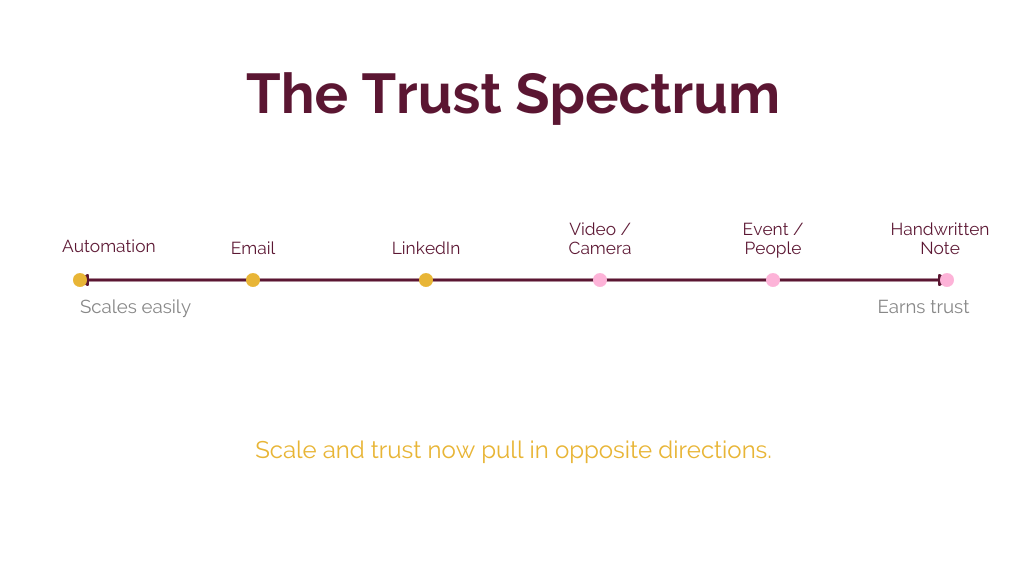
The Demand Gen Report’s insights from B2BMX 2026 landed with a thud for anyone who’s been investing heavily in outreach automation. The finding, blunt and inconvenient: handwritten notes, unedited live video, and intimate roundtables are outperforming polished automated campaigns.
Not in every context. Not for every metric. But in the one that matters most for pipeline: actually getting a response from a real human who wants to talk to you. Analogue and high-touch are winning.
The reason isn’t that automation is broken. It’s that it worked too well, for too long, for too many people. Every inbox is now fluent in the grammar of automated outreach. The slight personalisation that felt human two years ago reads as a mail merge today. The “just wanted to bump this up” follow-up that once generated responses is now correctly identified as step seven of a sequence. Buyers have developed an immune response, and it’s remarkably accurate.
The trust deficit is real — and structural
Digital channels have eroded trust so thoroughly that human channels have become the differentiator. That’s a significant shift. For most of the last decade, the advice was to scale what works, more touchpoints, better tools, and tighter targeting. The automation arms race made sense when buyers were still engaging with it.
Now the channel itself is the signal. A polished, sequenced, perfectly timed email tells a buyer something before they’ve read a word: this person is not actually thinking about me specifically. The production value that once conveyed professionalism now conveys volume.
Contrast that with a handwritten note or a short, slightly rough LinkedIn video recorded on someone’s phone, or being in a room with fifteen people who all have the same problem you solve. The imperfection is the point. It signals effort, intentionality, and the willingness to do something that doesn’t scale.
The counter-intuitive case for doing less
For fintech founders who’ve spent real money building outreach infrastructure, this is an uncomfortable message. The answer isn’t necessarily to rip it all out. Automation still has a role, in nurture tracks for warm contacts, in keeping in touch with a broad audience through content, in operational follow-up. But as a primary acquisition channel for new conversations, it’s increasingly fighting against itself.
The counter-intuitive case is for doing less, slower, with more intentionality.
- Instead of five hundred sequenced emails, what if you sent twenty genuinely personalised ones; each one written knowing something specific about that person’s current situation?
- Instead of a polished webinar with a deck and a speaker bio, what if you hosted a working lunch for eight people and just had a real conversation?
- Instead of the perfectly produced LinkedIn carousel, what if you recorded a two-minute, unscripted reaction to something happening in your market right now?
None of these scale in the traditional sense. That’s precisely why they work.
What this means if you’re building a fintech
If your ICP is buying committees at financial institutions, compliance-sensitive, conservative about new vendor relationships; the trust deficit is even more acute. These buyers have been burned by slick pitches before, they’re not going to respond to more polished automation. They’re going to respond to someone who clearly knows their world, has something worth saying about it, and chose to say it to them specifically.
The firms getting traction right now are doing fewer things with more care. A handful of introductions made through people who will vouch for them. Content that takes a real position rather than hedging for maximum reach.
The automation paradox isn’t a reason to panic about your tech stack. It’s a reason to interrogate your strategy. Ask not how do we reach more people but how do we make the right people actually feel reached.
The answer, in 2026, probably involves a pen.
Latest posts
June 8, 2026