Why customer acquisition costs are rising across B2B and what founders with lean teams can do about it.
If you’ve noticed that your marketing budget doesn’t go as far as it did two years ago, you’re not imagining it.
Customer acquisition costs have risen 40–60% since 2023 across B2B technology and financial services broadly, not just fintech. The combination of more competition, tighter privacy rules reducing ad targeting accuracy, and simply more businesses running paid campaigns has driven prices up across every major channel.
For fintech specifically, the numbers are sharper. Average CAC for an SMB-focused fintech now sits around $1,450 / approximately £1,150, and that’s before you factor in compliance and onboarding costs, which can add another 30–50% on top.
Here’s the explanation.
The channel you’re probably relying on has become much more expensive.
Most B2B companies in the early-to-growth stage are running some combination of LinkedIn ads, Google search, and maybe some content marketing. LinkedIn in particular has become the default B2B paid channel, and the prices reflect that.
LinkedIn CPC now averages £5–£13 for standard Sponsored Content, rising to £12–£20 or more when you target senior decision-makers such as CFOs, heads of compliance, or C-suite. That’s up roughly 8–12% year on year since 2024. LinkedIn’s global ad revenue is projected to hit $9.7 billion in 2026, up from $8.2 billion last year. (Source: Stackmatix)
None of that means LinkedIn doesn’t work. It does, for the right objectives. But if you’re using it primarily to drive demo requests or form fills, you’re paying a premium for a channel that increasingly works better earlier in the buyer journey, building awareness and trust, than it does as a direct response tool.
The channels got more expensive. The playbook most companies are running didn’t change to account for it.
Why does this hit harder when you don’t have a marketing team?
If you have a senior marketer in-house, rising CAC usually prompts a strategy conversation: what’s the channel mix, are we measuring the right things, where should we reallocate?
If you don’t, i.e. if it’s you, maybe a junior person, or an agency or freelancer running campaigns, the response is usually one of three things:
1. Assume the agency needs better creative and ask for new ads.
2. Increase the budget to chase the same volume of leads.
3. Cut spending because it’s not working and park the problem.
None of these addresses the underlying issue, which is structural rather than executional.
The structural issue
Paid advertising is mostly used to capture demand that already exists. It finds people who are already actively looking for what you offer and puts your name in front of them. That’s valuable, but when the pool of actively looking buyers is small, and everyone is competing for the same clicks, the economics get painful fast.
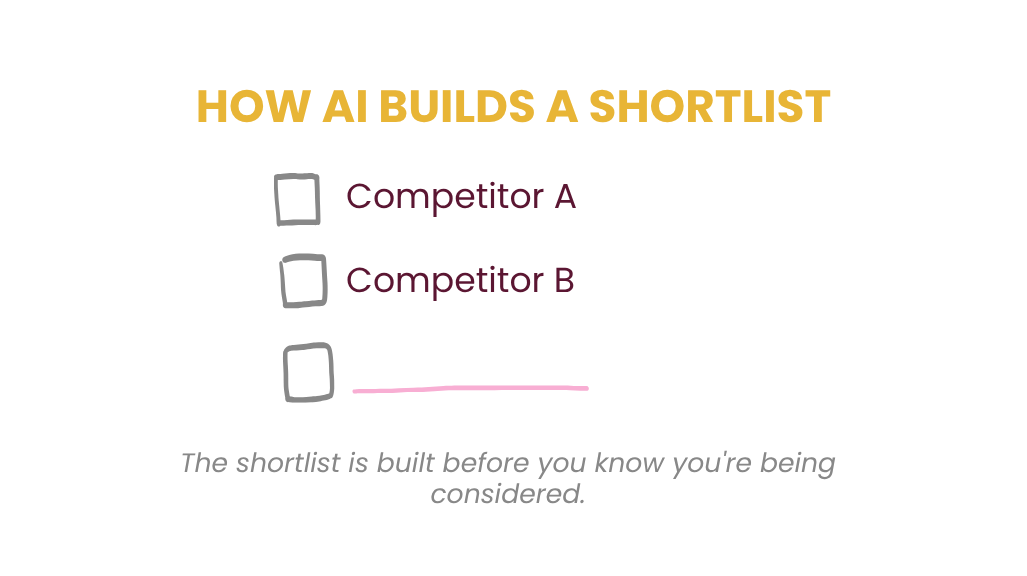
Most ad specialists will tell you to run a brand awareness component alongside this, and that’s the right advice. It’s also how paid media can contribute to getting you on a shortlist before procurement starts, or building familiarity before a buyer ever speaks to you. But it’s slow, it’s expensive, and because its impact doesn’t show up as a lead, it’s usually the first thing cut when budgets tighten.
The cheaper version of that same effect happens outside paid media: reputation, content, and relationships that build familiarity and trust without paying for every impression. That work happens elsewhere. In a high-CAC environment, this matters more.
The metric worth switching to
Most early-stage businesses measure cost-per-lead. It’s visible and fast-moving, which makes it feel like accountability.
The problem is that cost-per-lead tells you how much you spent to get someone into the funnel. It says nothing about whether the unit economics of your growth actually make sense. The metric worth watching instead is CAC payback period; how long it takes to recover what you spent acquiring a customer, in gross profit terms.
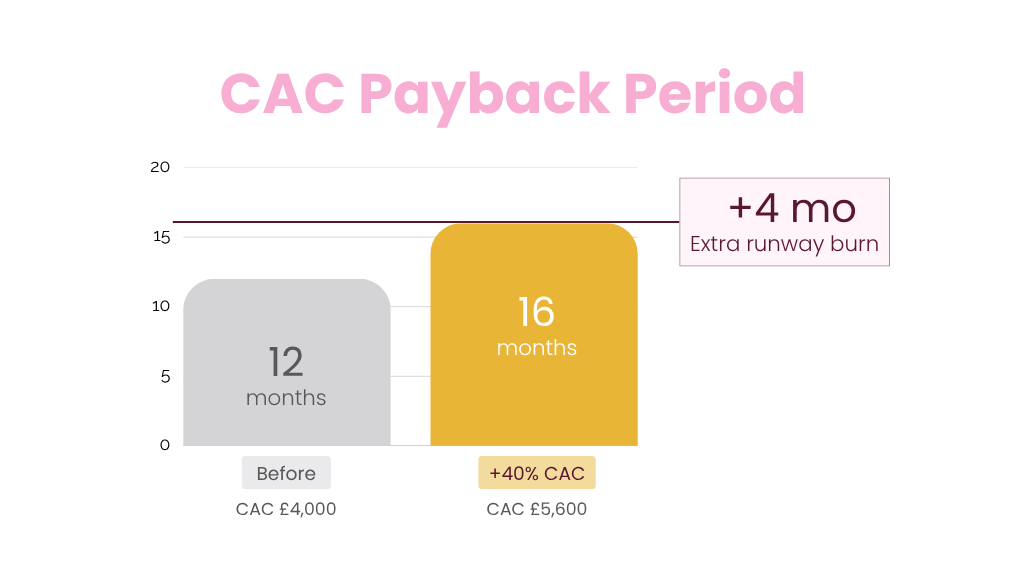
For example, if you spent £20,000 on sales and marketing last month and acquired five customers, your CAC is £4,000. If each customer pays £500/month at a 70% gross margin, you’re recovering £350/month per customer. Payback period: just under 12 months.
Now apply a 40% CAC increase to the same model. You spent £28,000 to acquire those same five customers, so CAC is now £5,600. Same product, same price, same five customers. The only thing that changed is the cost to find them. That same calculation now shows a payback period of just under 16 months. For investors and for your own runway planning, that can be a meaningfully different position.
A healthy B2B SaaS payback period is under 12 months; under 18 months is still acceptable. Above that, you’re funding growth with capital rather than revenue, which is only sustainable if you have the cash to do it deliberately. (Source: SaaSUltra.)
What actually changes the trajectory
Optimising your existing paid campaigns harder, better creative, tighter targeting, and lower CPC will get you some of the way. But it won’t close a 40% gap. The founders managing acquisition costs well aren’t just running their current playbook more efficiently. They’re also putting money into things to warm up the buyers before they’re ready to raise their hand, because a warm buyer costs significantly less to convert than a cold one.
- Reputation and visibility in the right places. If the first time a potential customer encounters your brand is an ad, you’re already competing on equal terms with everyone else running ads. If they’ve seen your name in a trade publication, heard you speak at an event, or read something useful you wrote, you’ve moved up the shortlist before anyone’s had a conversation.
- This matters especially in financial services. Regulated businesses buying fintech products apply a higher standard of scrutiny to new vendors than most sectors. Trust has to be established somewhere, and content and reputation do that work far more credibly than advertising.
- Referrals and relationships. A referred customer typically costs a fraction and converts faster than one acquired through paid media. (Source: Phoenix Strategy Group.) If you don’t have a deliberate referral or partner process, you’re leaving the cheapest acquisition channel underused.
- Content that earns a shortlist position. Not content for content’s sake, but specific, useful material that answers the questions your buyers are actually asking at the point they’re doing due diligence. A CFO evaluating your product is looking for evidence of expertise and reliability, not another case study in the same format as everyone else’s.
None of this means stopping paid. It means not making paid carry the entire load.
What this looks like practically, without a marketing team
If you don’t have a senior marketer, the instinct is to outsource all of this to an agency and ask them to sort it. That works for execution, but it rarely works for the strategic question of where to focus.
A few things that can move the needle without requiring a full marketing function:
- Your own voice, used consistently. A LinkedIn presence where you write honestly and usefully about the problems your customers face, not about your product, builds credibility over time at close to zero cost. It takes time. It compounds.
- One or two media relationships. Being a reliable, quotable source for journalists covering your sector generates visibility that paid media can’t replicate and signals credibility to buyers who research you.
- A structured referral ask. Most founders don’t ask existing customers for referrals in a way that actually produces them.
- Reviewing what your paid spend is actually doing. Not whether the ads look right, but whether the campaign objectives match where your buyers actually are in the journey. Awareness objectives and conversion objectives cost differently and serve different purposes.
None of this requires a full marketing hire. However, it does require treating marketing as a business question, not just an operational one.
The broader point
Acquisition costs going up across B2B isn’t a temporary blip. The factors driving it; more competition, more platforms, buyers doing more research before engaging, privacy changes reducing targeting accuracy. These are structural, not cyclical.
The businesses that will look back at this period well are the ones that used the pressure of rising CAC to build marketing assets with compound value: reputation, content, relationships, referral infrastructure. These things don’t show up in a CPC dashboard. They do show up in the cost of your next hundred customers.
The businesses that respond by optimising spend on the same channels will find the ceiling sooner than they expect.
Latest posts
June 8, 2026