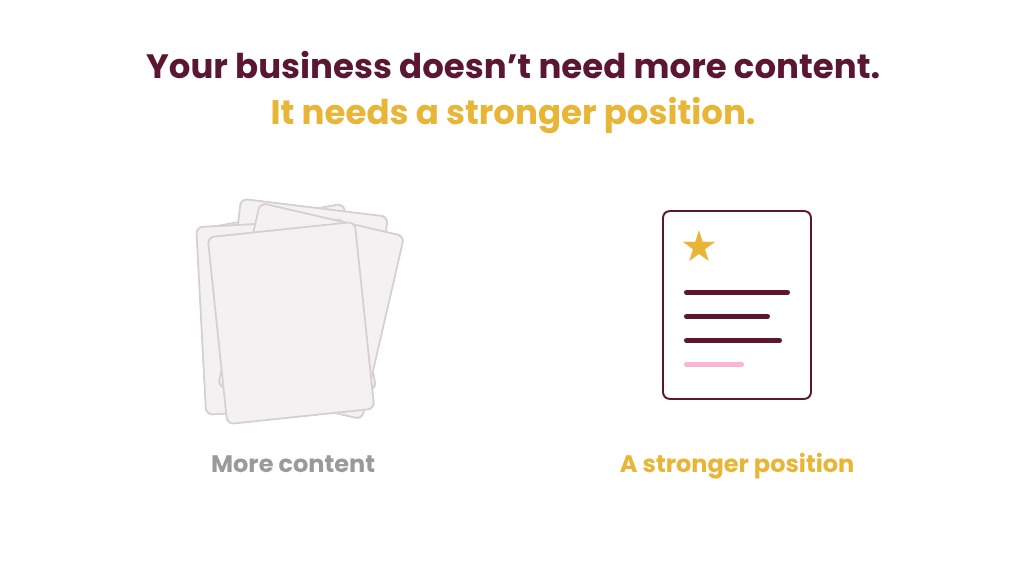
Your business doesn’t need more content. It needs a stronger position.
This piece was prompted by Andrew Holland’s “The Mad Men Era of SEO” in Search Engine Land (April 7, 2026). What follows isn’t a summary, but what the argument means if you’re building a business.
There’s a version of marketing advice that sounds productive but quietly sends you in the wrong direction: publish more, post consistently, stay visible. The logic is hard to argue with on the surface. If you’re not showing up, you’re not being considered.
But showing up and being recommended are different problems. And right now, the gap between them is widening.
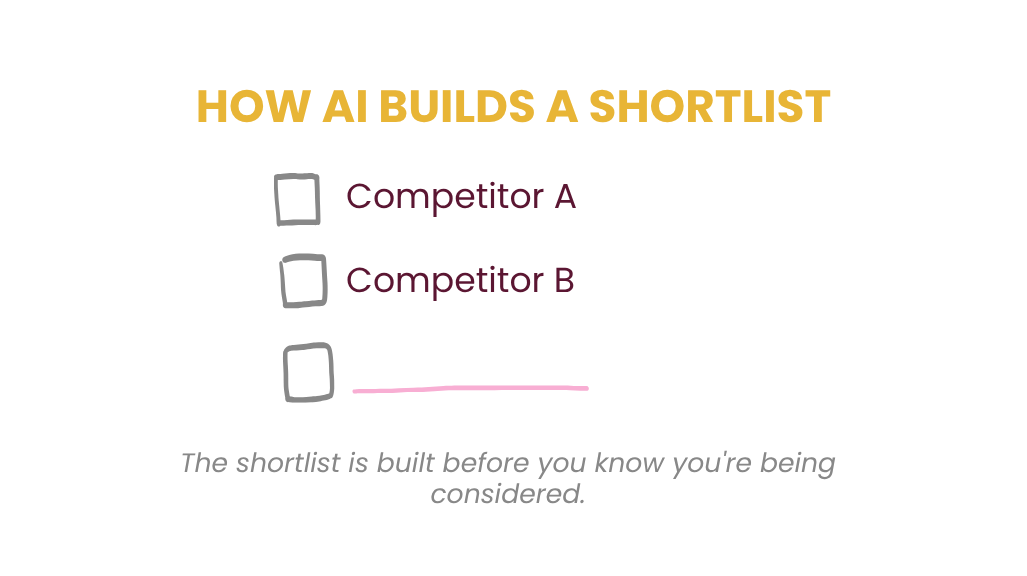
AI systems: the ones people increasingly use to research, compare, and shortlist, don’t reward the most prolific brands. They surface the ones with the clearest argument for why they’re the right choice. That’s a positioning question, not a content volume question.
This isn’t an argument against content. It’s an argument for doing it in the right order.
Describing what you do isn’t the same as arguing for it
If someone described your ideal client’s problem to an AI and asked for a recommendation, what would your website argue? Not describe, argue. There’s a difference.
Describing what you do is a list of capabilities: “We help businesses with marketing strategy, content, and demand generation.” Arguing for preference means answering something harder: who specifically is this for, what problem do you solve better than the alternatives, and why should anyone believe you?
Most businesses can describe. Very few can argue.
The instinct at early stage is understandable: stay broad, keep options open, don’t close doors before you’ve walked through them. But vague positioning doesn’t protect optionality. It just makes you harder to recommend.
A quick test: read your homepage as if you’ve never heard of your business. Does it make a case or does it just explain what you sell?
The proof problem and what to do before you have credentials
This is where most early-stage founders assume they’re off the hook. No case studies yet. No client logos. No testimonials. “We’ll sort proof once we’ve got clients to point to.” The problem is that proof isn’t just case studies. It’s anything that makes a claim checkable.
I’m in this position myself with Firefinch Marketing. No published case studies yet. No long client list. And yet credibility is still buildable; through the thinking you put out publicly. A budget framework. A CRM piece built on firsthand implementation experience. An article that applies someone else’s research to a problem you see in your own client work. None of that requires tenure. It requires a point of view and the discipline to express it.
That’s what early-stage proof looks like: not a client list, but a visible track record of how you think. A framework that shows your methodology. An article that takes a position. A former employer, collaborator, or beta user willing to say one sentence on the record.
The businesses that struggle with AI visibility and with conversion tend to share the same profile: plenty of content, claims they can’t evidence, and positioning broad enough to mean nothing. Starting intentionally, even with limited credentials, is how you avoid ending up there.
Three things to do before you add more content
1. Write your positioning in one sentence.
Not a tagline, a specific claim. “I help [type of business] solve [specific problem] by doing [what you do differently].” If you can’t write it, or it sounds like it could describe five of your competitors, that’s the gap. Work on the sentence before you work on the editorial calendar.
2. List your proof points: everything you actually have.
Not what you wish you had. What exists today: past experience, published thinking, frameworks, a pilot outcome, a recognisable name who’ll vouch for your work. If the list is short, that tells you what to build toward — not with more content, but with intentional outputs that evidence your claims. A methodology you can name. A guide that shows how you think. A talk, a podcast appearance, a co-authored piece.
3. Google yourself, then ask an AI.
Search for your name and your business. Then ask ChatGPT or Perplexity to recommend someone who does what you do. See what comes up. If you’re not there, or if what appears doesn’t match how you’d want to be described, you have your answer on where to focus.
Content built on top of a clear position compounds.
Content built as a substitute for one just creates noise and the systems people use to find and evaluate businesses are increasingly good at telling the difference.